May 26, 2026
Introduction
Humanity has officially returned to deep space.
In April 2026, NASA successfully completed the Artemis II mission, sending astronauts around the Moon and safely back to Earth for the first crewed lunar mission since Apollo 17 in 1972. The historic flight marked the first time in more than five decades that humans traveled beyond low Earth orbit and ventured into deep space.
But Artemis II is more than a symbolic return to the Moon.
The mission represents the beginning of a long-term strategy to establish a sustained human presence on the lunar surface, develop lunar infrastructure, and prepare for future missions to Mars.
As governments and private companies accelerate investments in lunar exploration, Artemis II may be remembered as the mission that launched a new era of space exploration.
What Was Artemis II?
Artemis II was NASA’s first crewed test flight of the Orion spacecraft and Space Launch System (SLS).
The mission carried four astronauts:
Reid Wiseman (NASA)
Victor Glover (NASA)
Christina Koch (NASA)
Jeremy Hansen (Canadian Space Agency)
During the nearly 10-day mission, the crew traveled around the Moon and returned safely to Earth, completing critical tests of life-support systems, spacecraft operations, navigation technologies, and deep-space communication systems.
The mission reached a record distance of 248,655 miles from Earth, surpassing the distance record previously held by Apollo 13. The Orion spacecraft successfully splashed down in the Pacific Ocean on April 10, 2026.
Why Artemis II Matters
For many observers, Artemis II was a historic achievement.
For NASA, it was a critical systems validation mission.
Before astronauts can land on the Moon again, NASA must demonstrate that its next-generation spacecraft can safely transport crews through deep space and return them to Earth.
Artemis II successfully tested:
Deep-space crew operations
Orion spacecraft performance
Re-entry and heat shield systems
Long-duration lunar navigation
Human performance in deep-space environments
NASA officials described the mission as a foundational step toward future lunar landings and long-term exploration initiatives.
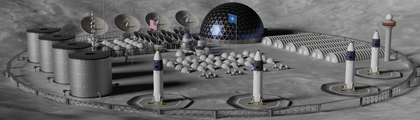
The Moon Base Vision: From Missions to Permanent PresencePerhaps the most important outcome of Artemis II is what comes next.
NASA is no longer pursuing short-term lunar visits. Instead, the agency is building toward a sustained lunar presence through the Artemis program.
The long-term goal includes:
Lunar habitats
Surface power systems
Scientific research stations
Autonomous robotic infrastructure
Resource utilization technologies
Recent NASA announcements reveal plans for lunar landers, rovers, cargo systems, and drone technologies that will support the construction of a future Moon Base near the lunar south pole.
The lunar south pole is particularly attractive because it may contain water ice deposits that could support future astronauts through the production of drinking water, oxygen, and rocket fuel.
This strategy transforms the Moon from a destination into an operational base for deeper space exploration.
The Rise of Commercial Space Competition
Another major story behind Artemis II is the growing role of private industry.
Unlike the Apollo era, modern lunar exploration is increasingly driven by partnerships between government agencies and commercial companies.
NASA has recently awarded contracts to several private firms, including:
Blue Origin
Firefly Aerospace
Lunar Outpost
Astrolab
These companies are developing landers, lunar vehicles, robotic systems, and infrastructure technologies that could support future Moon Base operations.
This public-private model aims to reduce costs while accelerating innovation.
The result is a rapidly expanding lunar economy where government missions and commercial ventures work together to establish a permanent presence beyond Earth.
A New Space Race Is Already Underway
The Artemis program is also unfolding within a broader geopolitical context.
Multiple nations are expanding lunar ambitions, including:
United States
China
European Space Agency partners
Canada
Japan
As lunar exploration becomes increasingly strategic, the Moon is emerging as the next major arena for technological leadership, scientific research, and resource development.
Many analysts now describe the current environment as a new space race—one focused not only on reaching the Moon, but on staying there.
NASA officials have repeatedly emphasized that Artemis is designed as a long-term exploration framework rather than a single mission series.
Scientific Discoveries Beyond the Mission
Artemis II was not only a transportation milestone.
The crew conducted scientific observations during their lunar flyby, including monitoring meteoroid impact flashes on the far side of the Moon and collecting data that could help researchers better understand lunar surface conditions.
These observations contribute to future planning for lunar habitats, astronaut safety systems, and long-term surface operations.
The mission also generated extensive imagery and engineering data that will help shape upcoming Artemis missions.
What Comes Next?
Following the success of Artemis II, NASA is preparing for the next phase of lunar exploration.
Upcoming objectives include:
Artemis III lunar landing mission
Deployment of lunar infrastructure
Surface mobility systems
Expansion of commercial lunar services
Development of the Artemis Base Camp concept
NASA recently announced additional Moon Base contracts and future mission planning efforts that could lead to sustained human activity on the lunar surface by the early 2030s.
The long-term vision extends beyond the Moon.
NASA sees lunar operations as a testing ground for future human missions to Mars.
Conclusion
The success of Artemis II marks one of the most significant milestones in modern spaceflight.
For the first time in more than 50 years, humans have traveled around the Moon and returned safely home. But the true significance of the mission lies in what it enables next.
From lunar bases and commercial space infrastructure to future Mars expeditions, Artemis II represents the beginning of a new chapter in human exploration.
The question is no longer whether humanity will return to the Moon.
The question is how quickly we will build a permanent presence there.
続きを読む


 +86 17354022649
 service@sondii.com


 IPv6 サポートされているネットワーク